


Project promotion
1. Supraśl-Balsthal promotional video production
To promote partnership activities, a video production has been planned. The film will be produced in three languages. It will present such issues as: history of the two partners, including the history of their cooperation and the essential characteristics of the both municipalities; natural environment, culture and tourism. The video will last about 30 minutes. This activity will be a cohesive element in the cooperation between Suprasl and Balsthal.
Supraśl - Poland's window onto Switzerland
2. Development and maintenance of a website for the project
Including: buying a domain and a server, website design, website updates – 26 months,
website’s translation into 3 languages – 26 months.
3. Preparation and printing of a book promoting the project "In Suprasl and Balstahl pot''
Including the essential contribution, purchase of pictures, translations, project, revisions, printing, quantity: 5000 pcs.
Activity 2 - “The Suprasl Canton'' Festival
Activity 2:
“The Suprasl Canton'' Festival (three-day festival, 2 editions)
“The Suprasl Canton" Festival will hold the following events:
1. Folk performances
2. Movie Night
3. Culinary competition "In Suprasl and Balstahl pot''
“The Suprasl Canton" Festival is a Polish-Swiss brainchild to promote cooperation between the two governments. The main idea is to promote Swiss and Polish cultures through presentation of films, folklore and culinary riches of the two regions. The planned three-day summer festival in Suprasl, will promote local folk bands and musicians from the regions of Podlasie and Balsthal, including among others, trumpeters and yodelling singers. There will also be organized a Film Night presenting films from Poland and Switzerland.
The festival’s final motive and the main subject will apply to culinary competition "In Suprasl and Balstahl pot''. The main goal of the competition is to present the culinary regional dishes of the both partners. The competition will be attended by the Polish and Swiss chefs who cooking their dishes will introduce regional culinary delights characterizing their regions.
The entire competition will be presented on a stage, where the chefs will cook live. Promotion of culinary delights will introduce the principle: “to the heart is through the stomach...'' and encourage the communities to open to new flavours. Through the exchange of experiences, there will appear a new quality in the cuisine of the two regions.
By exchanging regional recipes, chefs from the two countries, will enrich their menus promoting each other. The aftermath of the festival will be a richly illustrated book publication, containing historical, cultural and culinary elements of the two regions. The publication will also present recipes characterizing the two countries. The book will be in three languages: Polish, German and English, in order to promote the culture and co-operation of Suprasl and Balsthal partners not only in these two regions.
It was scheduled for two editions of the festival: in 2013 and 2014.
Partnership cooperation
Partnership cooperation
For a few years now, the Suprasl Government in collaboration with the Friends of Suprasl Society, has been actively pursuing the trendy watchword of integration, both within Poland and throughout the Europe. The efforts that are being made, aim at acquainting people of different nationalities and cultures with each other's cultural traditions, but also at exchanging experiences.
Informal, though active efforts on the development of cultural ties, began in the fall of 1993, when a group of the Swiss traveling in Poland, visited Suprasl. The guests were so enchanted with the city and its surroundings that they almost immediately invited a delegation from Suprasl to the Swiss municipalities of Balsthal, Dornach and Gelterkinden.
During the visits, the Polish delegates could familiarize with the specific of municipalities management in Switzerland, functioning of public utilities, education, government administration and social welfare. In 1997 a letter of intent was signed to take cooperation between the municipalities. The culminating moment of these contacts, was the signing of Cooperation Agreement on October 3rd, 1998 in Suprasl. The document signed by representatives of the both municipalities establishes cooperation in the fields of culture, arts, sports, science, education and the sphere of economic activity.
The successfully developing cooperation with the Swiss friends become the basis for contacts with the German Municipality of Großenkneten. The first contacts took place in 1997, and two years later a partnership agreement was signed in Suprasl. It was agreed that the cooperation will cover the following areas: arts and culture, science and education, natural environment, sport and tourism, economy, school exchange of pupils, and charity.
Between 1999 and 2000, the Government of Suprasl Municipality and the Friends of Suprasl Society participated in the European Union’s program CANDLE and after its termination there was also established contact with the community of Bridgend County in Wales. The result of previous contacts with a group of Welshes was the appointment of the Friends of Suprasl Society in Porthcawl in autumn 2000. The both societies agreed to establish a permanent cooperation and implement a program of partnership and friendship between the municipalities of Supraśl and Porthcawl. The official signing of the agreement with the Welshes took place on April 21st 2001 in Suprasl. The agreement contains a commitment of the both sides about setting and developing cooperation and friendship in the field of arts and culture, sports and tourism, science and education, environmental protection, charity and school exchange of pupils. The aim of these noble activities is strengthening friendship between the peoples and the need to develop relationships and cooperation in various fields.
Within the last 19 years the Municipality of Suprasl was visited by about 350 people from Balstahl, including:
● Friends of Suprasl Society members,
● representatives of Suprasl community,
● pupils and students from Suprasl schools,
● choirs and cultural associations operating in the Municipality of Suprasl.
In turn, there were 400 representatives of the Municipality of Suprasl who went to Switzerland.
In addition to partnerships with Balstahl, the Municipality of Suprasl formed cooperation with the following cities:
Großenkneten (Germany) May 4th 1999,
Porthcawal (Wales) 2001,
Zgierz (Poland) October 5th 2001,
Druskininkai (Lithuania) June 26th 2004
History
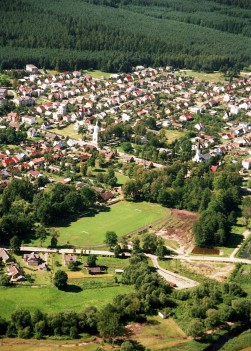 There is just one town at Podlasie hidden in the middle of the Knyszynska Forrest of over 500 years tradition that had inscribed with golden letters into the history of Poland, Belarus and Lithuania. This unique place is situated on a large clearing and it is Suprasl.
Although the "official" story begins with settling the monks of St. Basil the Great rule in 1500, archaeological sites from the Stone, Bronze and Iron ages, move back the metric of settlement in this area of at least 2-3 thousand years back.
Near the “Puszcza” Center a stone ax characteristic to the corded-ware culture was found, and the area of the monastery – a precisely made tip for arrows and a flint knife. A sensation was the discovery of a number of bronze clasps (fibula), which are derived from the fourth century A.D. and were the product of Wielbark culture. Also at the monastery were discovered pottery dated back to the thirteenth century, and in 1975 were found two early-iron axes (dating back to the eleventh century). Similarly, on a Suprasl dike situated in the valley of the river (near the end of the Nowy Swiat street) a spear with an iron tip dated back to 13th to 14th century was discovered. Analogous tips assigned to Jacwings were discovered 10 km from Suprasl in the nearby village Sokolda (Municipality of Suprasl). These findings demonstrate that even in the Middle Ages, the current area of Suprasl was penetrated by people. Medieval monuments from Suprasl and the surrounding area can be seen in the Little Historical Museum of Knyszynska Forrest at Arboretum on Kopna Gora near Suprasl.
Prehistoric settlement in the vicinity of Suprasl (near Podsuprasl), was confirmed by excavations carried out in 2004 at the home of Debowik. On the large lagoon terrace scientists have acquired about 2,000 pieces of pottery and several thousand flint creations, among which an arrowhead (Bronze Age), and kunday armour (Mesolithic) are of particular interest. The oldest monuments can be dated back to the 9th millennium before Christ, and the youngest to the Iron Age.
Ceramic ware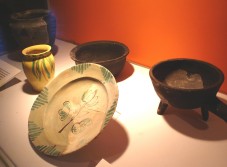
Among the pottery discovered at this position were fragments decorated with herringbone stitch and negative cord. Ornaments show that the dishes were created by people from corded-ware culture, and "herringbone" refers to an early stage in the development of this community. The corded-ware culture was one of the Neolithic communities. It developed at the end of the third millennium B.C. (between 2450 and 2000 B.C.). This included areas of Europe from Finland to Switzerland, and from the Rhine to the upper and middle basin of the Dnieper.
Long before the rise of the monastery complex, high escarpment riverside was a convenient place to set up a camp. Access to the holm of Suprasl was almost from every side defended by forests, marshy meadows, Suprasl river and Brzozowka and Grabowka rivers (now streams). The "fortified" location also fostered secluded life of schimick - hermits who isolated themselves from the religious community and spent their life alone in their self-made hermitages. According to tradition, monastic hermitages remittances were situated on the first high slope at the bottom of the river, near the “Puszcza” Recreation Centre on the so-called “pan”, which is today part of Suprasl. Even in the early 19th centur the place was called "Uroczysko Hermitage".
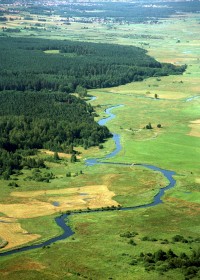 Landscape of the Suprasl River
Due to the natural and landscape values of Suprasl, the monastery chronicler in the 18th century, aptly named the place beautiful, peaceful and useful. People living here in prehistory and in modern era felt healthy and safe. And so it is presently ... It has been scientifically acknowledged that climate in Suprasl healthy, air filled with essential oils derived from coniferous trees as well as medicinal mud located near the Sokolda village. As you seen, it was not a coincidence that Suprasl has been credited to an elite group of Polish health resorts ten years ago.
Suprasl is a beautiful town which with great history and potential. Not only can one relax, heal strained health, but also regenerate spiritually... Every day in this place will bring discovering something new, provides a lot of emotions, causes delight, a mood of blissful reverie ... Time spent in Suprasl, is not time wasted.
Zwiastowania NMP Male Monastery
The modern history of Suprasl begins in 1500, when Alexander Chodkiewicz, coat Kościesza, court equerry, hospodarski marshall, and Nowogrodek governor since 1544, expressed his consent to the establishment of a Greek-Ruthenian- Byzantine monastery in the site of the present Suprasl. This same Lithuanian gentleman, born about 1457, the son of Ivan the governor of Kiev, in 1498 first brought of Saint Basil the Great rule monks form Kiev and the Holy Mount Athos to Grodek. After two years, due to the inconvenience of monks reside in 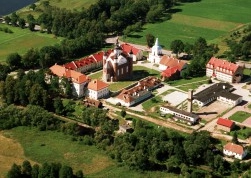 populous and bustling Grodek, the monks asked their benefactor to move them to different location on the same river. The founder of the monastery allowed to move their headquarters from Grodek to a new, peaceful place, but the choice of a new religious establishment was left to the Providence. This story, in form of a legend is given by the mid-eighteenth century monastery chronicle written by an Uniate monk Fr Mikolaj Radkiewicz, a wice vicar of the Basilian Abbey:
... First in the 1498 in Gródek this Monastery had begun to be endowed by Alexander Chodkiewicz, Nowogrodek governor and Grand Marshal of the Grand Duchy of Lithuania in the lands of their inheritance, four miles by here, and there on the first fund he settled religious order of St. Basil the Great, not making them any records, and the first one was the Superior or hegumen, Paphnutiusz Sieheń. And when monks disliked this location in two years, they asked the founder to be founded on other quieter place. This lord allowed them to sought the take. And already having a consensus of the founder, made a wooden cross and let go from Grodek by the Suprasl River with the intent which place it stops, there they would content with. It was the providence of God for such a beautiful, peaceful and useful site named Błudowske Hrudzie in the forest, the hereditary estate of their founder, finding the bright cross by the Suprasl River, they announced it to their founder, who having moved from Grodek started funding. In 1500 Pafnucjusz Siehen, the first hegumen or archimandrite of Suprasl Lawry moved following the will of the founder to this holm placed between two streams and rivers Grabovka and Berezovka, cum communitate sua where this lord firmly and motionlessly founded this place. At the beginning a small church under the name of St. John the Evangelist was built ....
At the beginning Alexander Chodkiewicz did not make any grants to monks, until in 1506 Archbishop Jozef Soltan gave the monastery estates with subjects in Topilec, Baciuty and Piszczewo that he received from King Alexander Jagiellonczyk for the loyalty and involvement in the defence of the Duchy of Lithuania against Moscow's aggression.
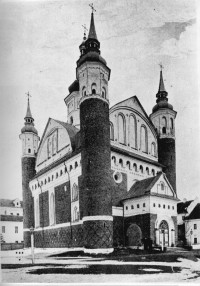 Zwiastowania NMP Orthodox Church
The symbol of Suprasl was and still is the Gothic Zwiastowania NMP Orthodox Church. Although the original building from the beginning of the 16th century, was blown up during the Second World War (1944), currently the towers of reconstructed temple dominate the city. In “ZIEMIA” journal from 1931 it was aptly written that:
The Orthodox Church building raised in the shape of a rectangular arena, with four defensive towers and a dome above the nave, resting on four pillars, fundamentally has eastern system, but the Gothic architecture of windows and ceilings, and subsequent Baroque additions, in details give the edifice a western stigma. Of all the monumental temple, both the external shape and from its interior, speaks to us in a strange harmonize of the Greek culture and Latin rite, something like East and West shaking each other hands, praising one Christ in Slavonic and Latin ...
The origins of the monastery
he Suprasl Monastery was really combining not only architectural styles, but also different philosophical and religious sentiments. Russians living in the eastern part of the Knyszynska Forrest were open to Western culture and religious rapprochement with Catholics and other Latins living in the same forest complex. The location of Suprasl between the two directions of settlement, as well as on the border between the Crown and Lithuania, favoured tying contacts, exchange ideas and somehow determined the role of the monastery as an intercultural bridge. That monastery perfectly encapsulated in the Jagiellonian idea of the state combined by a personal union of the common monarch, in which the Polish, Lithuanians and Russians felt brothers.
The drama of Orthodox Christianity tear in 1054, dividing it to the Church of Rome and the Eastern Churches, caused the attempts to fix Orthodox Church and Catholic Church, especially under the influence of the common to Greeks and Romans - the Council of Florence (1439). One of the attempts to integrate the church coincided with the rise of Suprasl Monastery. Shortly after agreeing to the establishment and making sacrifices by Metropolitan of Ruthenia, Joseph Bułharynowicza, the same supervisor of Orthodox Church, on August 20, 1500, not making the act of disobedience to Constantinople, made the act of obedience to Pope Alexander IV. In this way, he referred to the attitudes of his predecessors. Unfortunately, a religious war denounced by Moscow (dictated by resentment against the aspirations of conciliation), lost by Lithuania and the danger of further territorial cessions to the State of Moscow, led to the abandonment for some 100 years unification trends in the Polish-Lithuanian Orthodoxy. After the death of Bułharynowicza (1501), the new Metropolitan of Minsk, Jona has not established communication with Rome, and in 1503 even re-sacrificed the religious buildings in Suprasl that three years earlier were blessed by Bułharynowicz, known in the annals of Moscow as an enemy and an apostate of the Greek faith.
In 1545 fire caused by a lightning burned a wooden church of St. John the Evangelist, and probably the icon of Our Lady of Smolensk and Saviour in it, donated by Metropolitan Joseph Bułharynowicz on the occasion of blessing Suprasl temples.
Catacombs
During the sixteenth century, a brick refectory was built, and after 1545, a monastery tomb - catacombs with Zmartwychwstania Chrystusa Orthodox Church. In addition to the catacombs gardens, fields and even a winery were built. A monastic library was organized, where eminent humanists and people of art were arriving.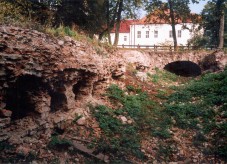
In addition to fish ponds supplying refectory tables in Lenten food, in the 16th century 2.5 km artificial canal was built in the valley of the river Suprasl, called Kopanice, New River or Dug River by the contemporary. At the end of this channel, about 300 years older than the Augustow Channel, an eight hectares mill pond was built with mills, sawmills and fulleries with millers settlement. Now this unique and well-preserved tailings dams system, despite the opposition of the city authorities, has been entered in the register of monuments under the name of Suprasl Water System.
Since the 1545, the Greek Orthodox convent superiors were given the dignity of Archimandrites - abbots, who had earlier been only superiors. The first archimandrite who was holding the honorable dignity was Kimbar Sergei (1545-1565), one of the most enlightened theologians of the Polish-Lithuanian Orthodoxy. He proposed religious reforms. There will be no exaggeration in saying that he found a wooden Suprasl and left it brick, because he introduced many useful masonry investments, fulfilled by masters from Vilnius. His remains were laid in the catacombs.
Basilian period - Uniate
After 1596, the monastery in Suprasl adopted the provisions of the Orthodox lords Synod of Brest, where the Orthodox Church of Rzeczpospolita and the Church of Rome were 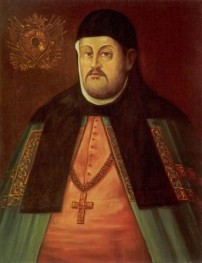 incorporated. Although initially the superior of the monastery, Archimandrite Prince Illerion Massalski resisted to the union and participated in the anti-Uniate Synod of Brest, after some time, he willingly surrendered to the Uniate Metropolitan, Hipacy Pociej.
Not abandoning Russian religious and cultural traditions, but accepting and completing them with Latin and Polish elements, Suprasliensis convent became one of the most important intellectual centers of the Units in Rzeczpospolita.
Since adoption of the Union of Brest between 1601 and 1603, up to 1839, the convent of Suprasl was the only autonomous monastery in Poland . It was not subject to the authority of Basilian congregations established in the 17th and 18th centuries, centrally managed similarly the Society of Jesus: Lithuanian (Trojcy Swietej Church) and Polish (Opieki NMP Church). It depended solely on the Metropolitan and the Holy See. The abbots in Suprasl were the highest dignitaries of the Uniate Orthodox Church in Poland, including the Metropolitans of this Church.
Between the years 1695-1803 there was monastery typography in Suprasl. During 108 years of their activity, monastery printing presses printed 452 nowadays registered books, 73% oh which are printed in Roman type, while 27% of the Cyrillic alphabet. Following Dr. Maria Cubrzyńskiej-Leonarczyk:
"The Basilians were the elite of Rzeczpospolita society, that has tied its fate to the Greek Catholic Church - the Uniate. Followers of the Uniate rite, among whom were not only Ukrainians, as it is commonly believed today, but many Belarusians, Polish, Lithuanians, sometimes Russians – they all cherished Ruthenian Orthodox traditions and customs while recognizing the primacy of the pope. The Basilians, and with them the Uniates were like a bridge not only between the two churches (Orthodox and Catholic), but also between the culture of Western Europe and the culture of the East remaining under the influence of Byzantine. In this way they were fulfilling a kind of a mission and Suprasl publishing facility also served to this mission".
Annexations. Removal of the monastery and russification
Cultural mission of the Basilians from Supra was interrupted by annexations of Polish land. First, the Prussians, and then after 1807, the Russians took the Basilians' land and appointed subsidy paid annually, which was not enough even for basic expenses. In 1803, under the influence of invaders' strict policy, ceased to exist the Uniate publishing house, which for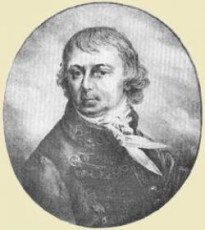 example in 1792 for the first time released a book of “Pieśni nabożne” by Franciszek Karpinski, which included some sung up today: “Kiedy ranne wstają zorze”, “Wszystkie nasze dzienne sprawy”, and a Christmas Carroll “Bóg się rodzi”.
In 1839 tsar's administration abolished the Uniate Greek Orthodox Church, including its properties, the clergy and followers in the Russian Orthodox Church. At that time in Suprasl was created an Orthodox monastery, that at the beginning was de facto a "The Uniates tomb." It was a place of dying for the Basilians who grew up in a completely different tradition and could not fully find themselves in a new political and religious situation.
In the mid-nineteenth century, the Archimandrites Palace and a part of the south wing of the monastery was sold to William Frederick Zachert. Orthodox monks (initially they were Basilians), lived in a detached house called Zaczek, occupied a gate and a part of the south wing of the monastery. Although a large part of the former monastery was sold to Zacherts, the planned liquidation of Suprasl monastery did not take place. A person who contributed to this decision was its superior Mikolaj Dalmatow – a Russian nobleman who ordered the arrangement of the convent archives, resurrected the forgotten since the Uniate devotion to Saint Mary of Surasl, rebuilt the Orthodox Church of Saint John the Theologist adjacent to Zaczek, and cared about education of local children. These days there was a three class Archimandrite monastery's school, which was attended by boys of different faiths from Suprasl. In the school children were taught it in Russian spirit.
The Monastery after 1915
In 1915, during World War I, Russian monks left Suprasl leaving all the monastery belongings. Abandoned monastery buildings were occupied the German soldiers, remaining in their walls until the beginning of 1919.
After regaining independence by Poland, the abandoned monastery was leased by the State Treasury to Catholic Church, which in 1937 organized there an educational institution and the oratorio, supervised by the Salesian order. The World War II interrupted the educational work of the congregation.
 After September 17th, 1939 taken over by the Red Army, the monastic buildings became a military garrison. The Soviets "cleansed" inside the Zwiastowania NMP Orthodox Church. In the furnace of the monastery laundry they annihilated the most beautiful iconostasis in Rzeczpospolita made by masters from Gdansk in the 17th century, and processed paintings on copper plates into "ornamental" soldered kettles and cups.
After the war, ruined monastic buildings were rebuilt and Technical College of Agricultural Engineering was organized there. After a long dispute, by the decision of the Polish government in February 1996, school buildings were transferred to the Polish Autocephalous Orthodox Church, which since 1982 is reconstructing the church, beautifies the adjacent area and develops charitable and cultural activities.
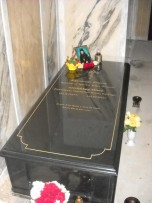
The great merit of Archimandrite Father Miron Chodakowski was restoration of the monastery in 1984 and the worship of Saint Mary of Surasl. Father Miron Chodakowski was a former Archbishop in Hajnowka and a head of the Orthodox Ordinariate of the Polish Army in the rank of general of brigade. The priest, died on April 10th, 2010 near Smolensk in a crash of the presidential plane. According to his last will and testament, the body was buried in the rebuilt Zwiastowania NMP Orthodox Church in Suprasl.
The town's history
The Supras monastic settlement in the 17th and 18th centuries had no values, of a “town”, but it was not a village. Its community served in the monastery and the abbey farm, including in particular the work in manufactures located in Suprasl Zajma-binduga. Everyday tasks of the Suprasl residents in the 16th to 18th centuries resulted from the everyday needs of monks: victualling, sacramental services, organization of grange-serf system, working in the printing, paper mills and other factories. In the period of the partitions, Suprasl was a place of prayer and meditation. For this reason, the monastery was rather suppressing the development of a village, not allowing the formation of a bustling town.
For the first time Suprasl appeared in written sources as a town in the Bull of Pope Pius VI in 1798, establishing Suprasl capital of the Uniate bishopric. Although in the church sources, the place was described in terms of a town, it was known the term “town” is exaggerated. According to medieval tradition, bishoprics were founded in towns, and the status of Suprasl was embarrassing at this point. Therefore, Suprasl was granted the title of bishopric conditionally and it was hoped for its quick development. It was explained in a Papal document:
„" On their own motives, in unmistakable conviction, under the full apostolic authority, the above mentioned settlement Suprasl we consider worthy and appropriate to be renamed the town of Suprasl, awarding it all the rights, privileges and prerogatives, which other cities, with their capitals, residents use, have, and can enjoy now and in the future will use, possess and enjoy either way ... "
Directing the development of Suprasl by Pisusa VI was also for economic reasons. Since the liquidation of Rzeczpospolita and acquisition of monastic properties by, the development and maintenance of the abbey depend on the economic efficiency of the monastery settlement. In order to improve the economic existence of the abbey, the Basilians leased from Prussia (and after 1807 from the Russians) the taken over by the invaders “Suprasl property”, which included industrial facilities in the form of 2 mills, 2 fullers, a sawmill, a brewery, two taverns, distillery, brick manufacture and paper mill.
Renovating mills and fulleries, building a brewery, new paper mill, farm house and other buildings, the Basilians caused that influx of craftsmen sub-leasing the facilities. Many of them had German names appearing in the book of baptisms in Suprasl Basilian parish and were Lutherans.
In particular, the person mostly anxious about development of the settlement, was the monastery abbot and the last bishop-nominee of the Suprasl diocese - Leon Ludwig Jaworowski coat Lubicz. After the liquidation of the Suprasl diocese in 1809, head of the Basilian monastery wanted to bring to Suprasl expensive Brest diocese offices, with a seminar, consistory and the private residence of the bishop. During three decades Jaworowski doubled the number of residents in Suprasl changing its character.
Even before the introduction of customs barriers on goods exported from the Polish Kingdom to Russian market after the November Uprising, Suprasl began to have a town character. Therefore in the first sentence of the monastery inventory of 1829 it was said that the monastery was in
"a town called Suprasl".
Although the modernization of Suprasl industry up to 1830 claimed more than 70% of the total expenditure of the monastery, the project to move the Brest diocese was not feasible. Government in St. Petersburg opposed restricting their policy towards Uniates. Abbot Jaworowski had remorse. The huge amount of funds he invested in the farm, seemed to be for nothing. He wrote in the inventory of the monastery:
... But when the higher power liked it other way, I could be the only one ashamed of my mistake, but in my conscience I hope that God will not require the count from me .
Cytron’s Factory
Bishop Jaworowski ‘s mistake turned to become a "blessed mistake" because it resulted in significant acceleration of Suprasl development. From Abbot Jaworowski’s plans benefited mostly industrialists who starting in 1831 took over the lease of the former monastic property with Basilians’ manufacturies. In their place they organized textile factories. Since February 1831, the monastery farm was leased by a German textile manufacturer Huffert, and since November by another manufacturer, Roter. The third leaser of the Basilians’inheritance at Zajma in Suprasl was Wilhelm Fryderyk Zachert – a textile manufacturer from Zgierz (1834). Within the next two decades, this manufacturer turned the 300 inhabitants monastery town, into a “real” town raising the number of citizens to 3450 in the 1857. The most numerous group were Catholics (2086), followed by Protestants (790), Orthodox (327) and Jews (227).
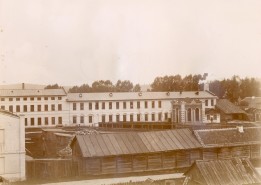 Zachert was followed by and other industrialists: Buchholzes, Reichs, Jansens, Aunerts, Alts, Koszades, Tebuses ... and a multitude of skilled craftsmen. They all moved to Suprasl from the Kingdom of Poland in fear of bankruptcy. High tariffs on textiles exported to the Russian Empire, introduced after the November Uprising, did not allow them to continue development. The only chance for continued prosperity was to move their munufactories to Bialystok District, within the limits of the Russian Empire. In this way, Suprasl became in no time an important center of textile industry in the District of Bialystok and Grodno Government. The end of the textile industry finally came only with the World War II.
In the 19th century in Suprasl were settling mostly Jews with shops, bakeries and inns. With the help of Suprasl industrialists a synagogue at ul. Zgierska (out November 11) was built, but during the World War II it was destroyed by Germans.
Suprasl today
Presently, Suprasl with approximately 4.5 thousand residents tends to become tourism – health resort. The town and municipality is governed by a Mayor and City Council. The town guests Podlasie Province cultural institutions such as the Museum of Icons and "Wierszalin" Theatre.
Supraśl is also a city of education because there were as many as three schools established: Arthur Grottger Art School, Education Center (the former ZSMR) and Sports School. Within the city are numerous associations of which the most famous are Uroczysko, Friends of Suprasl Society and Collegium Suprasliense. At the Orthodox monastery also performs the Suprasl Academy initiating cultural, scientific, charitable and pastoral events. The important Suprasl body for the promotion of natural and cultural heritage is Witold Slawinski Knyszynska Forrest Landscape Park, brought to life in 1988.
Suprasl has 3 parishes: two Roman Catholic and one Orthodox. About 85% of the population are Roman Catholics, and the rest are Orthodox Christians and followers of other faiths.
The event of historical significance was granting Suprasl the title of a resort on December 28, 2001. Joining an elite group of Polish resorts was unique in the history of the town, and it is still waiting for the next ...
Author: Radoslaw Dobrowolski
About the project
"Suprasl – the Polish window on Switzerland" The project is co-financed by Switzerland under The Swiss Program of Cooperation with The New Member States of The European Union.
Total cost of the project - 884 700.00 PLN
The amount of funding (Swiss grant) - 615 098.00 PLN
Suprasl Municipality contribution - 269 602.00 PLN
The project is based on long-term cooperation between Suprasl (Poland) and Balsthal (Switzerland) municipalities. It aims at strengthening partnership through the launch of new joint activities and exchange of experiences in the field of cultural, social and natural science, the construction of long-term relationships through the exchange of social groups and organization of initiatives, such as participation in trade fairs and conferences.
Through the project activities such as: organizing concept tours for leaders and regionalists, organization of the Festival, production of a video film about Balsthal and Suprasl as well as the publication of “In Suprasl and Balstahl pot”, organizing international conference, the project fulfils the objectives of the Partnership Fund.
There will be realized assumptions of promoting and strengthening cooperation between the Polish and the Swiss local government units, social institutions, non-governmental organizations and local communities. There will also be implemented a joint actions in the field of environmental protection, tourism and culture, as well as promotion and exchange of best practices from the range of socio-cultural and natural heritage, which are the main elements of the Partnership Fund.
The target group of all promotional activities of the both sides - Polish and Swiss, of the book and the film will be: local communities, environmental protection, culture and tourism institutions, regional governments, non-governmental organizations, potential tourists.
The entire project is based on promoting activities of the partnering municipalities of Balsthal and Suprasl. All the initiatives undertaken will bear logos of the financing institutions. At the beginning of the project a website will be launched, providing information on the partnering municipalities – about their history, natural, cultural and tourism conditions, so that every user entering the website could obtain information about each of the partners. It will provide information on the financing institution, the project, activities, news and pictures from trips, info about conferences and the Festival.
All publications, leaflets, video, conferences and post-conference materials will include logos of the financing institution. During the Festival and the conferences there will appear organizers’ and funding bodies logos in multimedia form.